
Uncertainty Quantification#
Surrogates occasionally make large errors even on familiar datasets. CODES provides optional deep ensembles (modalities → uncertainty) so you can quantify confidence and fall back to the numerical solver when needed.
Deep Ensemble basics#
Enable by setting
uncertainty.enabled: trueandensemble_size: Min your training config.Training seeds are offset per ensemble member so each model explores a different region of the loss landscape.
During evaluation, predictions are averaged across members; the standard deviation across members becomes the predicted uncertainty.
What it buys you#
Potential accuracy gains — averaging multiple members can reduce variance and improve mean performance, especially on noisy datasets.
Reliability signals — high predicted uncertainty correlates with large actual errors, enabling selective trust or fallback strategies.
Costs#
Training time scales linearly with
Mbecause each ensemble member is a separate task (see the modalities guide).Inference time also scales with
Mwhen you request uncertainty-aware predictions, though most CODES surrogates have lightweight forward passes so the overhead is modest.
Evaluation hooks#
Enable the
uncertaintymodality pluslosses/compareevaluation switches to generate catastrophic-detection plots, uncertainty-vs-error correlations, and ensemble statistics.Use the outputs to design thresholds (e.g., “re-run the numerical solver when predicted uncertainty exceeds X dex”).
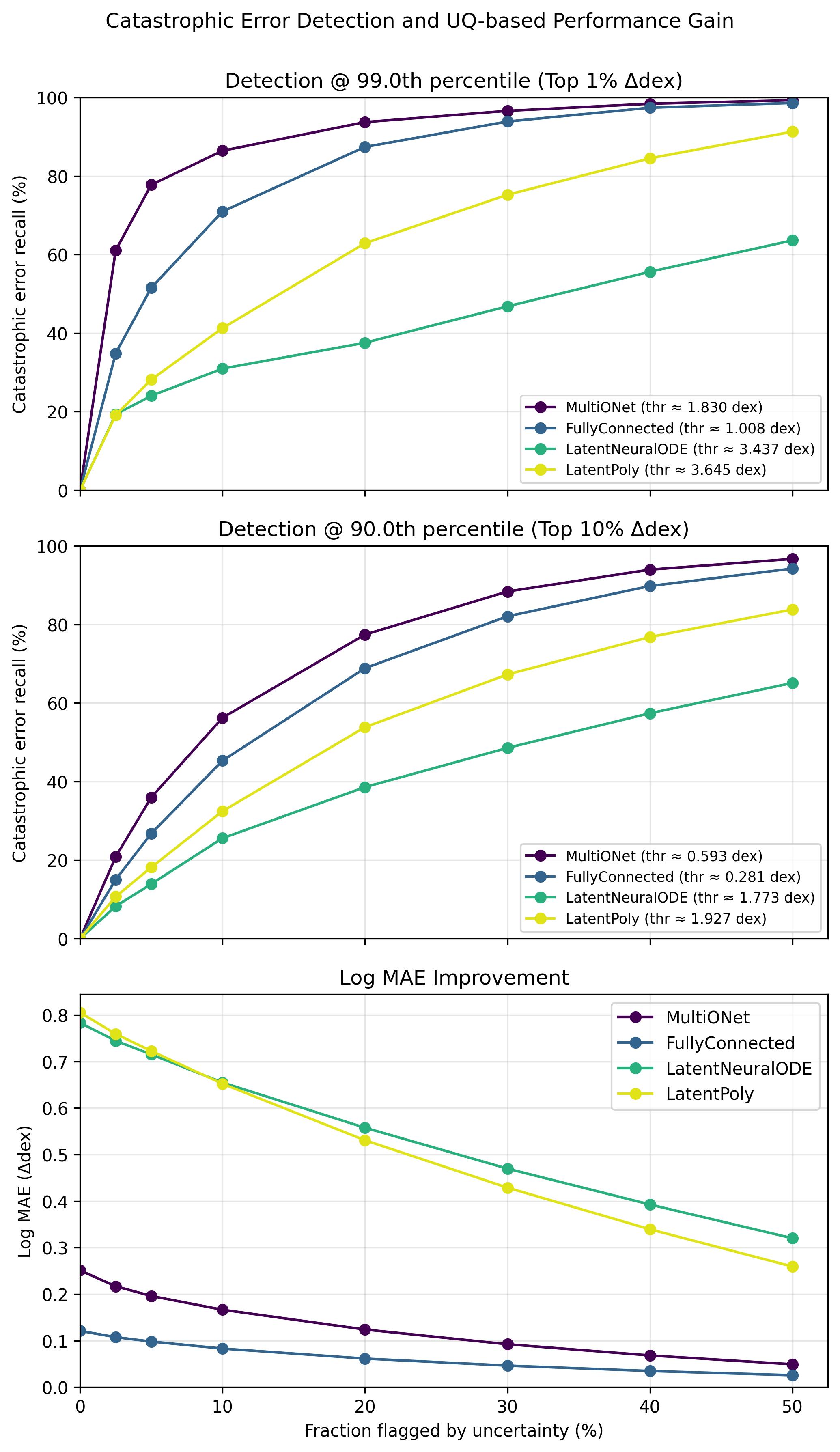
Deep Ensembles can flag catastrophic errors: the higher the percentile of the predicted uncertainty you filter out, the lower the residual MAE.#
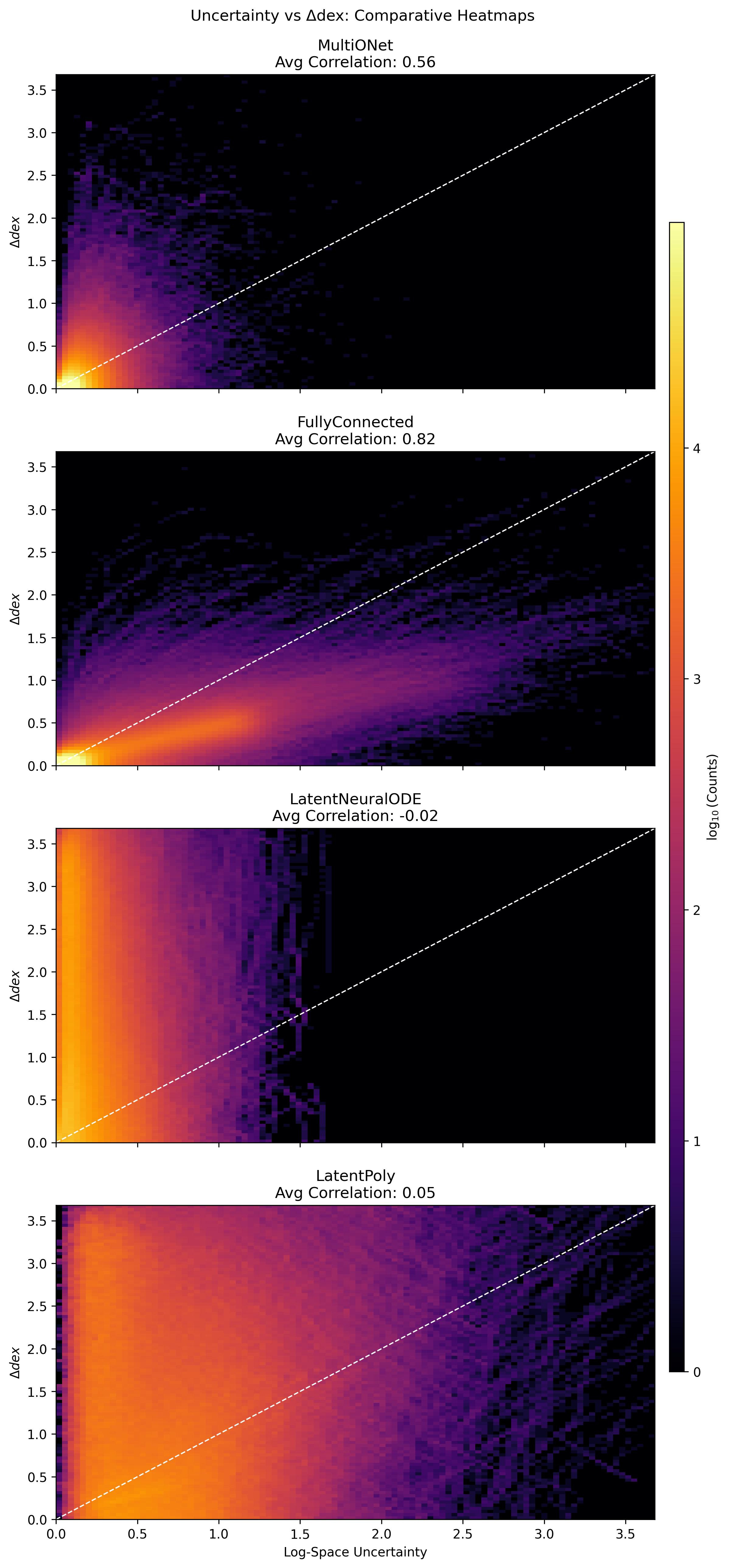
Heatmaps show how predicted uncertainty correlates with true error, giving you confidence that the ensemble is well calibrated.#
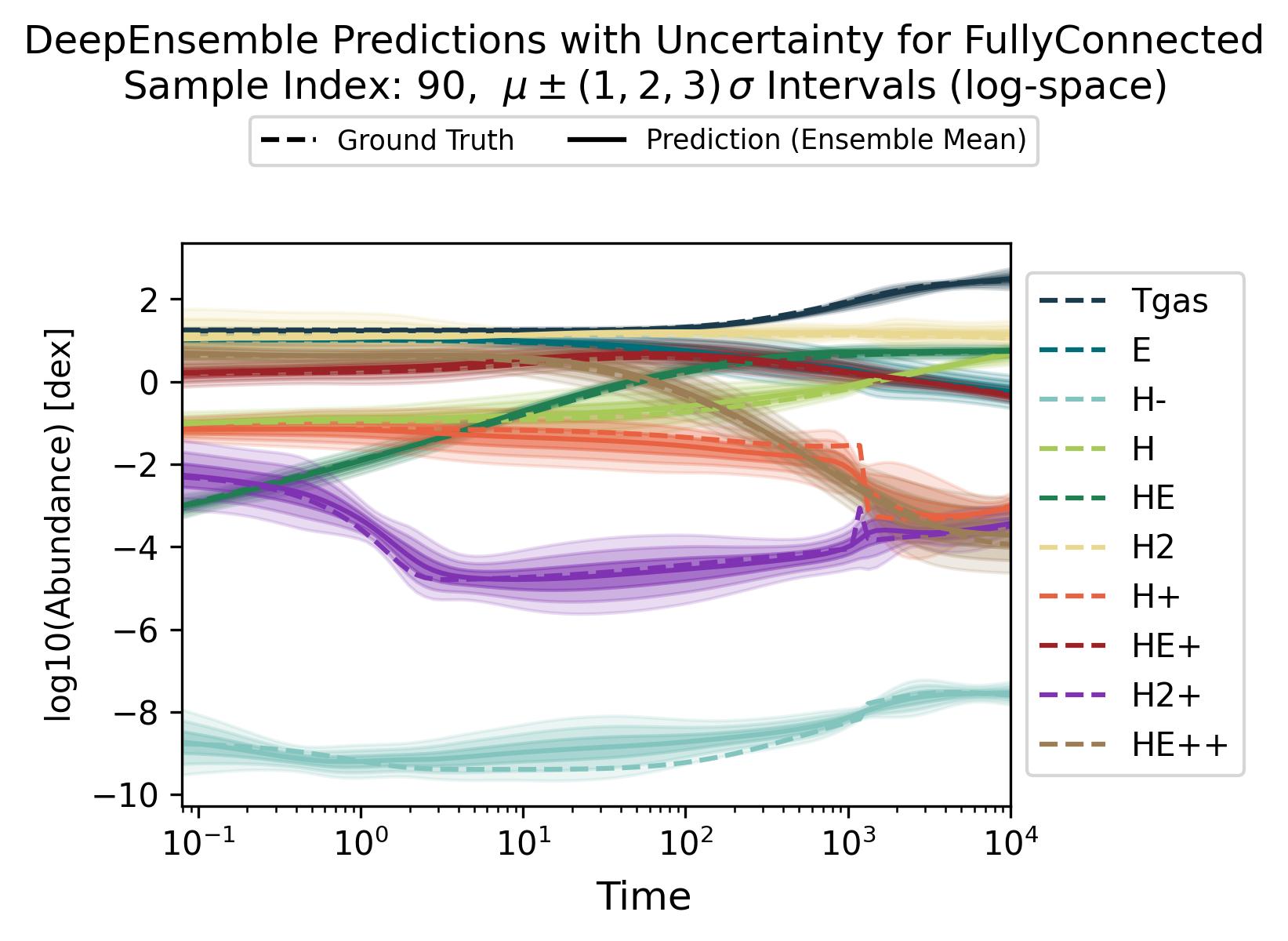
Ensemble members provide a distribution over trajectories; the mean prediction (solid) and spread (shaded) highlight regions where the solver may need to fall back to ground truth.#
Deep ensembles are currently the default UQ mechanism, but the interface leaves room for future methods (e.g., MC Dropout, SWAG). Whatever approach you adopt, test it in the evaluation stage to ensure uncertainty signals align with actual errors.